
Source-checked quantum knowledge base
Understand quantum computing. Prepare for what it changes.
Plain-English explanations of how quantum computers work, what they could do, and why they put today’s encryption at risk, with the standards, deadlines and migration steps that follow.
Published by OptimaTech, an IBM Silver Partner. Every fact links to its original source. Our editorial principles
Deadlines to watch
As of 14 Oct 2026
2030Hong Kong · HKMA aims for full banking-sector quantum readiness
2030Australia · ASD recommends ending traditional asymmetric cryptography
2030United States · Executive Order 14412: federal high-value and high-impact systems move key exchange to PQC (signatures by 2031)
2035United Kingdom · NCSC target to complete PQC migration
Why it matters
The next leap in computing will not just be faster. It will be different.
For seventy years, computers have improved by packing ever more transistors onto silicon chips. Quantum computers take another path. They use the physics of single atoms, particles of light and superconducting circuits cooled close to absolute zero to process information in ways that ordinary computers cannot imitate efficiently.
Today’s machines are still small and error-prone. But the world’s largest technology companies have published roadmaps to large, error-corrected quantum computers, and governments are already preparing for what happens when they arrive.
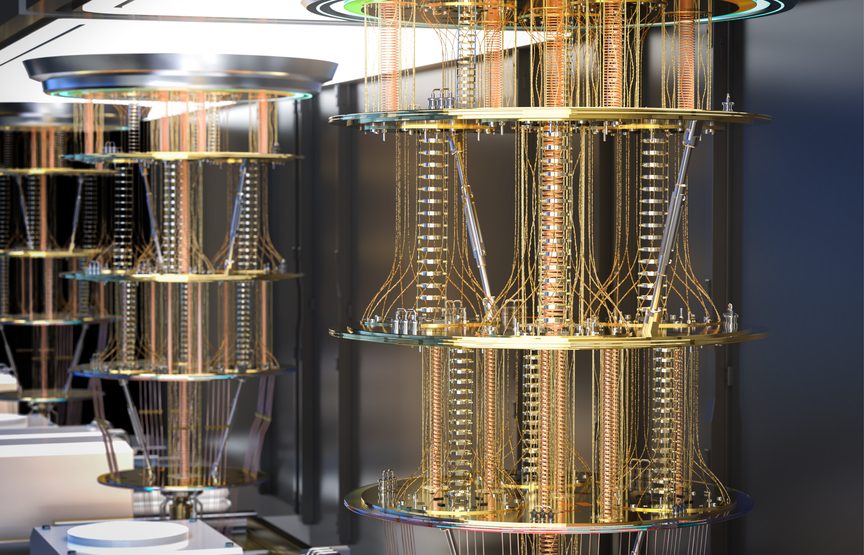
What changes when quantum computers arrive
Discovery
Scientists could simulate molecules and materials directly instead of approximating them, opening new routes to medicines, batteries and catalysts.
Industry
Companies in chemicals, energy, finance and logistics are already experimenting to find the problems where quantum computers will pay off first.
Security
The public-key encryption that protects websites, payments and identities could be broken. Governments have set migration deadlines around 2030 and 2035.
Strategy
Governments and companies treat quantum technology as a strategic capability, and many countries have published national plans for it and for the move to quantum-safe cryptography.
Quantum computing, explained
A new kind of computer, built on the rules of quantum physics.
Every computer you use today, from phones to supercomputers, processes bits: switches that are either 0 or 1. A quantum computer processes qubits. A qubit can hold a combination of 0 and 1 at the same time, and groups of qubits can be linked in ways that have no everyday equivalent. For certain problems, this lets a quantum computer explore possibilities in a way no classical machine can match.
Three ideas that make it work
Superposition
A qubit can be in a blend of 0 and 1 until it is measured. With n qubits, the computer works with a combination of 2n possible values at once: 300 qubits already describe more combinations than there are atoms in the observable universe.
Entanglement
Qubits can be linked so that their states are described together, not one by one. Measuring one tells you something about the other, however far apart they are. Entanglement lets qubits work as a single system.
Interference
Like waves on water, quantum states can reinforce or cancel each other. Quantum algorithms are designed so that wrong answers cancel out and the right answer becomes the most likely result when the qubits are measured.
Measurement ends the magic. When a qubit is measured it gives an ordinary 0 or 1. A quantum computer does not simply “try every answer at once”; the art is in designing an algorithm whose interference makes the useful answer the likely one.
How quantum computers are built
Fragile qubits, extreme engineering.
Qubits lose their quantum state when they are disturbed by heat, vibration, stray electromagnetic fields or even a single unwanted photon. This loss, called decoherence, is why quantum computers look nothing like ordinary servers. Building one means isolating qubits almost perfectly from the world while still being able to control and read them millions of times a second.
Colder than outer space
The leading superconducting machines, such as those built by IBM and Google, run their chips at around 10 to 20 thousandths of a degree above absolute zero (0.01 to 0.02 kelvin). That is roughly 150 times colder than the 2.7 kelvin of deep space. At these temperatures the circuits become superconducting and thermal noise is low enough for qubits to hold their state for long enough to compute.
Inside the refrigerator
Those temperatures are reached in a dilution refrigerator, a stack of plates that are each colder than the one above. The bottom stage uses a mixture of two helium isotopes, helium-3 and helium-4, to provide continuous cooling. The famous golden “chandelier” photographs of quantum computers show these plates and the hundreds of cables running between them. A lab-scale system draws several kilowatts of power, and IBM has built experimental refrigerators far larger than standard ones to make room for future machines.
Five ways to build a qubit
| Technology | How it works | Operating conditions | Examples |
|---|---|---|---|
| Superconducting circuits | Tiny electrical circuits on a chip, controlled with microwave pulses | About 0.01–0.02 K in a dilution refrigerator | IBM, Google |
| Trapped ions | Individual charged atoms held by electric fields and controlled with lasers | Ultra-high vacuum; ions laser-cooled to around a millionth of a kelvin | Quantinuum, IonQ |
| Neutral atoms | Uncharged atoms held in arrays by focused laser beams (“optical tweezers”) | Ultra-high vacuum; atoms laser-cooled to microkelvin temperatures | QuEra, Pasqal, Atom Computing |
| Photonics | Qubits carried by particles of light in optical circuits | Many designs need cryogenically cooled single-photon detectors | PsiQuantum, Xanadu |
| Spin qubits | The spin of single electrons in silicon chips, made with semiconductor-industry methods | Cryogenic temperatures, typically around or below 1 K | Intel, Diraq |
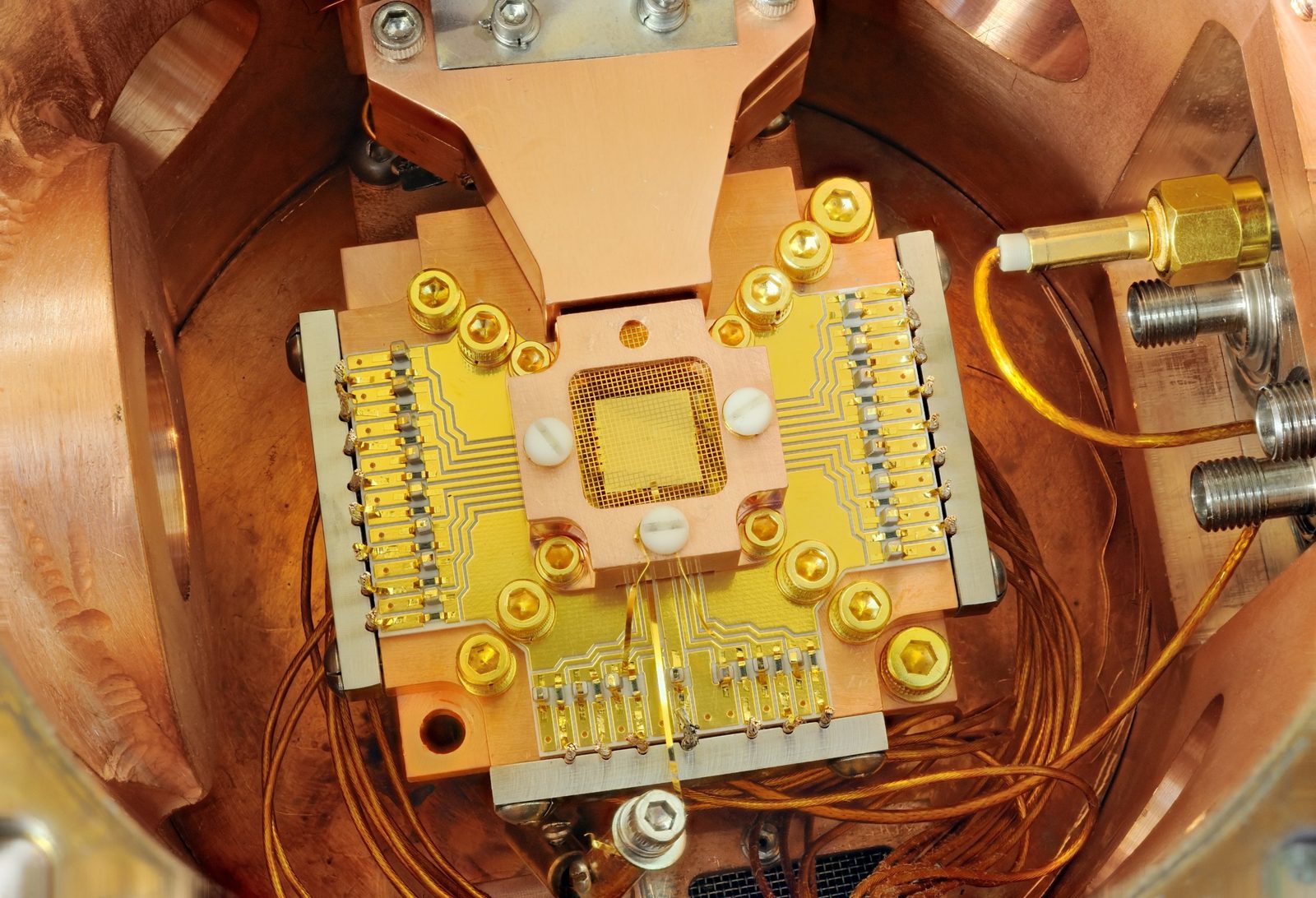
The engineering challenges
Isolation
Refrigerators and vacuum chambers must shut out heat, vibration and magnetic fields; even the cooling pumps must be kept from shaking the qubits.
Wiring and control
Every qubit needs control signals. Cables limited by cooling power and space, and electronics often larger than the chip itself, make scaling up hard.
Speed
Errors must be detected and corrected while the computation runs, which needs fast classical computers working alongside the quantum chip.
From physical qubits to logical qubits
Today’s qubits make errors far too often for long calculations. Quantum error correction combines many physical qubits into one more reliable logical qubit. A useful, large-scale machine will need hundreds or thousands of logical qubits, which means many thousands to millions of physical qubits. Reaching that scale is the central engineering challenge of the field.
- Quantum computing at the quantum advantage threshold: a down-to-business review (arXiv)
- NIST, ion-trap apparatus photograph (2011), via Wikimedia Commons, public domain
- Neutral atom quantum computing hardware: performance and end-user perspective (arXiv)
- IBM Goldeneye dilution refrigerator, as reported by The Quantum Insider
- Google, Meet Willow, our state-of-the-art quantum chip (Dec 2024)
Where the technology stands
Real progress, and an honest picture of what is still missing.
- 2019 · Google reported that its 53-qubit Sycamore processor completed a sampling task far faster than it estimated a supercomputer could. The task had no practical use, and the size of the speed-up was disputed.
- December 2024 · Google’s 105-qubit Willow chip showed error correction “below threshold”: as logical qubits were made larger, errors fell instead of rising, a long-awaited milestone published in Nature.
- May 2025 · A Google researcher estimated that breaking 2048-bit RSA would need fewer than one million noisy physical qubits running for under a week, down from about 20 million in a 2019 estimate.
- June 2025 · IBM published a roadmap to a large-scale, fault-tolerant quantum computer, Starling, targeted for 2029, designed to run 100 million operations on 200 logical qubits.
- March 2026 · The Global Risk Institute’s expert survey put the chance of a cryptographically relevant quantum computer within 10 years at 28–49%, the highest in the survey’s history.
- July 2026 · IBM and research partners reported experiments in which quantum results on specific physics problems could not be reliably reproduced by classical supercomputers, and submitted them to a public “quantum advantage tracker” for independent checking.
What does not exist yet: a fault-tolerant quantum computer large enough to break today’s public-key encryption, or to outperform classical computers on everyday business problems. Roadmaps point to the end of this decade for the first large error-corrected machines, but timelines in this field are uncertain.
- Google, Meet Willow, our state-of-the-art quantum chip (Dec 2024)
- Gidney, How to factor 2048 bit RSA integers with less than a million noisy qubits (arXiv, 2025)
- IBM roadmap to Starling, as reported June 2025
- Global Risk Institute, Quantum Threat Timeline Report 2025 (published Mar 2026)
- Arute et al., Quantum supremacy using a programmable superconducting processor, Nature 574 (2019)
What quantum computers could be used for
Not faster at everything, but transformative for some problems.
Chemistry and materials
Molecules follow quantum rules, so quantum computers are a natural fit for simulating them. Targets include better batteries, catalysts for cleaner industrial processes, and new materials.
Medicine and life sciences
More accurate simulation of molecular interactions could help researchers screen drug candidates and understand proteins, alongside classical computing and AI.
Optimisation and finance
Logistics, scheduling, portfolio and risk problems are being studied. Clear, proven advantages over the best classical methods have not yet been shown, and research continues.
Science and physics
Simulating quantum systems in physics is where the first credible advantage claims have appeared, as a research tool for scientists.
What quantum computers won’t do: they will not replace laptops, phones or cloud servers, and they will not speed up most everyday software. They are expected to work alongside classical supercomputers, handling the specific parts of a problem they are suited to.
What changes when quantum computers succeed
Breakthroughs for science, and a reset for digital security.
Science and industry
Faster discovery of materials, chemicals and medicines, where simulation is the bottleneck.
Finance
New tools for risk and pricing models, and an urgent need to protect payment systems, banking links and digital assets.
Government and defence
Strategic advantage for whoever builds large machines first, and decades-long secrets that need protecting now.
The biggest certain impact
Today’s public-key encryption stops being safe
A large enough quantum computer could break RSA and elliptic-curve cryptography, which protect websites, banking, VPNs, software updates and digital identities. New quantum-safe standards already exist; the challenge is replacing the old algorithms everywhere in time.
The quantum threat in one minute
Broken encryption is only the start.
A large quantum computer would undermine the mathematics behind today’s public-key cryptography. That affects far more than secrecy: it touches trust, identity, money and the evidence systems that organisations rely on.
Harvest now, decrypt later
Encrypted data copied today can be stored and read once a capable quantum computer exists.
Forged identities
Attackers could forge digital signatures and certificates, impersonating websites, banks or government services.
Poisoned software updates
With a forged code-signing key, malicious updates could look genuine to the devices that install them.
Stolen digital assets
Blockchains and payment systems that rely on elliptic-curve signatures could see funds moved with forged transactions.
Doubt over signed records
Contracts, records and audit trails protected by today’s signatures could become harder to rely on as evidence once those signatures can be forged.
Systemic financial risk
The G7 Cyber Expert Group warns that quantum computing could expose financial data and that upgrading the financial system will take many years.
Risks from the migration itself
New implementations can contain bugs: in 2024, researchers reported timing weaknesses (“KyberSlash”) in several implementations of Kyber, the algorithm that became ML-KEM. Larger keys can also break older devices and networks.
A quiet Q-Day
A capable machine may not be announced publicly, so organisations might not know when their data became readable. This is a scenario, not a prediction, and it is why agencies urge action before the date is known.
Because replacing cryptography across an organisation takes years, regulators have set deadlines around 2030 for high-risk systems and 2035 for the rest.
- US Treasury: G7 Cyber Expert Group statement on quantum computing risks (dated 25 September 2024)
- Global Risk Institute, Quantum Threat Timeline Report 2025 (published Mar 2026)
- Gidney, How to factor 2048 bit RSA integers with less than a million noisy qubits (arXiv, 2025)
- NIST FIPS 203, 204 and 205 (Aug 2024)
How ready is your organisation?
Take the free 10-question PQC readiness self-assessment and get suggested next steps in about 10 minutes.
Global PQC Regulation Tracker
Who expects what, and by when.
Every entry links to the original source and shows when we last checked it.
| Jurisdiction | Authority · document | Key milestone | Last checked |
|---|---|---|---|
| Hong Kong | HKMA · Quantum Preparedness Index | Sector score 2.3/10 (Jul 2026); full readiness targeted by 2030 | 14 Oct 2026 |
| Singapore | CSA · Quantum-Safe Migration Handbook | Critical infrastructure: plan by Mar 2027; migration complete by end 2031 | 14 Oct 2026 |
| New Zealand | GCSB · NZISM section 2.4 | No deadline set: agencies should inventory and prioritise quantum-vulnerable systems | 14 Oct 2026 |
| Australia | ASD · Information Security Manual | Stop using traditional asymmetric cryptography by end of 2030 | 14 Oct 2026 |
| United States | White House · Executive Order 14412 | Federal high-value systems: PQC key exchange by end 2030, signatures by end 2031 | 14 Oct 2026 |
| United Kingdom | NCSC · PQC migration timelines | Plan by 2028 · priority systems by 2031 · complete by 2035 | 14 Oct 2026 |
News & Insights
What happened, and what it means for you.
HKMA’s first Quantum Preparedness Index: what a 2.3/10 score means for banks
The regulator’s whitepaper sets a 2030 target. Here is what the index measures and what to do in the next 12 months.
How we help · Hong Kong and New Zealand
From first questions to a quantum-safe organisation.
PQC Insights is published by OptimaTech, an IBM Silver Partner. Alongside this free knowledge base, our teams in Hong Kong and New Zealand help organisations assess their readiness and deliver migration, using IBM Quantum Safe technology.
Readiness assessment
A structured review of governance, inventory, risk and roadmap against regulator expectations.
Cryptographic discovery
Find where vulnerable cryptography is used across code, networks and certificates with IBM Guardium Cryptography Manager, part of IBM Quantum Safe.
Migration support
Prioritise, plan and implement quantum-safe upgrades, with crypto-agility built in.
What is a qubit?
A qubit is the basic unit of information in a quantum computer. Unlike a bit, which is always 0 or 1, a qubit can be in a combination of both until it is measured, and qubits can be entangled with each other.
Will quantum computers replace normal computers?
No. They are specialised machines for particular problems, such as simulating molecules. Everyday computing will stay on classical computers, with quantum processors working alongside them.
When could a quantum computer break today’s encryption?
Nobody knows exactly. In the Global Risk Institute’s latest expert survey (published March 2026), experts put the chance of a cryptographically relevant quantum computer within 10 years at 28–49%. Regulators ask organisations to move high-risk systems to quantum-safe cryptography by around 2030.
What should organisations do now?
Start with an inventory of where public-key cryptography is used, prioritise systems that protect long-lived sensitive data, and build a funded migration plan using the new NIST standards.
Get the weekly quantum update.
One short email each week. No sales pitch. Unsubscribe any time. Launching soon: send us your work email and we’ll add you before the first issue.